How do we make every moment count?
Whitewall Creative is a 360° design, digital, and events agency. This is an exploration of what a creative agency website can do for the people it's trying to reach, built from research rather than assumption.
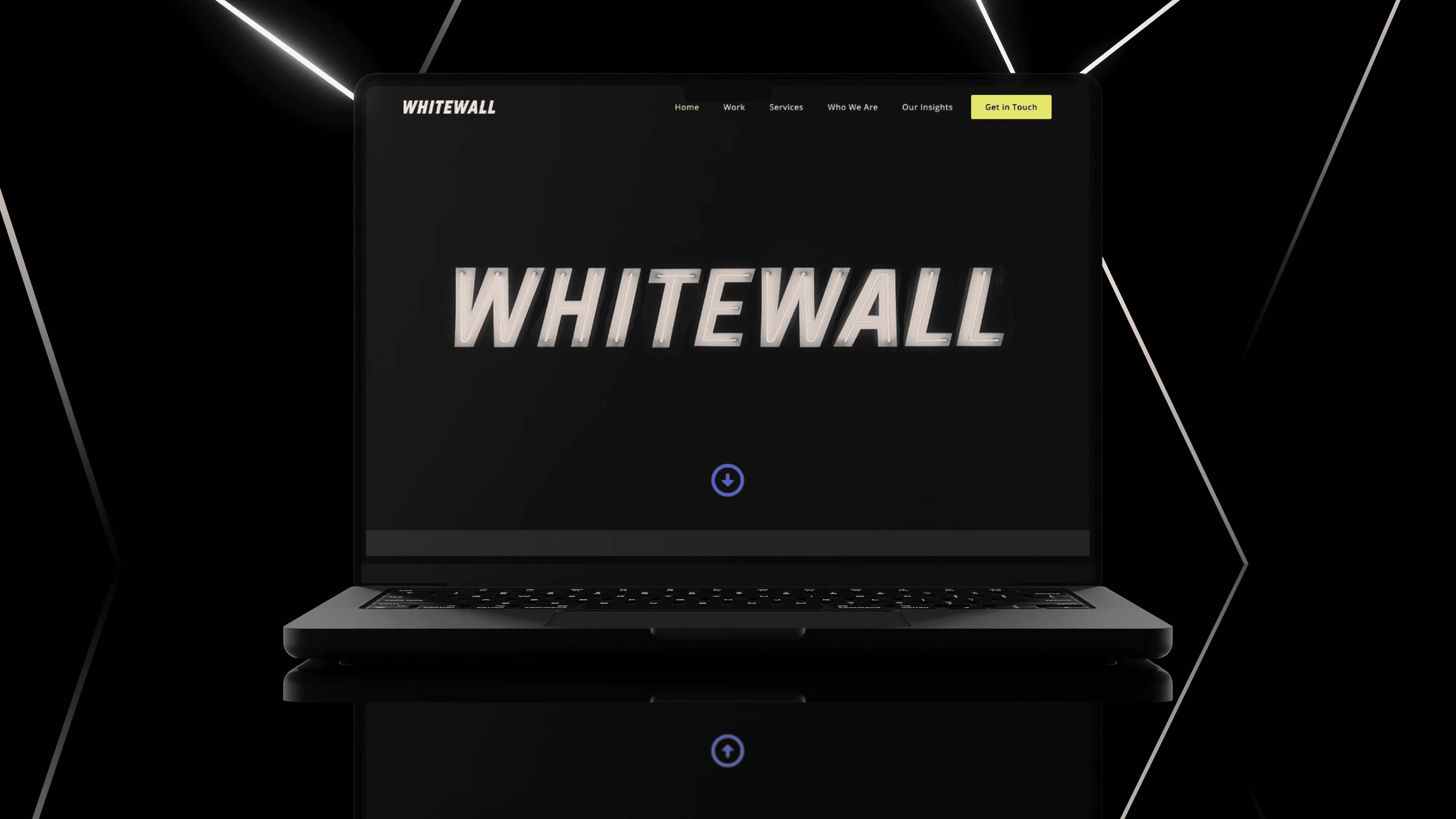
The companies best at telling other people's stories sometimes haven't had the bandwidth to tell their own.
Across the industry, creative agencies pour their energy into client work and let their own digital presence wait its turn. That's a fair trade-off. But it raised a question I wanted to explore: when a good-fit client lands on a creative agency's site, what makes them reach out, and what quietly holds them back?
So I took it on as a self-initiated project: not a redesign brief, but an exploration of what a site could do if it were built entirely around the person on the other end.
Below is the company solution reference point:


There are very few agencies doing exactly what Whitewall does. The ones that do it well make it easy to believe in them.
Competitive intelligence
The less obvious finding came from looking at the market more broadly. Most event companies don't offer design services. Most design agencies don't produce events. Whitewall does both, and there are very few others that do. That's a genuinely differentiated position, and it's also the thing that's hardest to communicate to someone arriving without context.
I wanted to understand two perspectives on the same site: the people it's trying to reach, and the team who relies on it to represent the company.
I interviewed three participants via 1:1 Zoom sessions: internal team members who use the site professionally, and a professional who works alongside the agency commissioning process, with regular contact with event and creative agencies, though not in the decision-making role itself.
Research Objectives
*A note on participants: This project was completed evenings and weekends alongside full-time work, which shaped what was practically possible for recruitment. I couldn't access direct clients, so my participant pool was proximate rather than ideal. In a commissioned engagement I'd recruit more directly from the target audience.
Everyone I spoke to said some version of the same thing: I need to know who you are before I can trust you with my brief.
Affinity Mapping
Affinity mapping converged on three groups: clarity and mutual trust, company culture and fit, and organic reach. Cross-referencing what the internal team needs the site to convey against what clients look for when evaluating a partner broke each group down further, into seven specific insights.
Clarity and Mutual Trust
Proof of expertise: Case studies and visible work carry more weight than any copy.
Confidence in delivery: Evidence of process, capacity, and follow-through matters as much as the portfolio itself.
Clarity on the offer: The 360° model is an asset, but only if visitors understand what it means for them.
Company Culture and Fit
Cultural fit: Clients want to understand the people and culture behind the work before committing.
Distinctiveness: Clients value a partner who gets room to flex creative muscles, not one delivering strictly by the book.
Ease of contact: Every participant wanted an early, low-friction route to a real conversation.
Organic Reach
Earned reputation: The team wants clients to come to them, not the other way round, but most work still comes from chasing leads.

Bold design, accessibility considered, seamless delivery. They need a partner who delivers without needing to be managed.

Every stage in Jordan's journey has a trust problem. The website is the first chance to start solving it.
Jordan's route to a partner isn't a funnel. It's a run of trust tests, and the website is the first.
Mapping Jordan's journey from first search to confirmed partner, four pain points kept resurfacing, each one just looking a bit different at each stage:
"I can't tell who to trust."
"I won't know if we click until it's too late."
"I'll end up managing them myself."
"When I'm finally ready, reaching out is harder than it should be."
These needs aren't assumed. Each one is lifted straight from the interviews: when participants said they needed proof before trusting someone with a brief, that became Jordan's need at Consideration. The map tracks where each one surfaces, and where the solution can answer it.
How might we make Jordan feel like they've already met their perfect match, before they've sent a single email?
How might we…
help Jordan feel they've already met their match before they've sent an email?
ease the path to those face-to-face conversations where fit gets decided?
Not everything could be built. I prioritised features that reduced friction and built trust, in that order.
*One thing testing reinforced: Insights deserved higher priority than I initially assigned it. An agency that has a genuine point of view is a stronger trust signal than I'd anticipated.

How do you make a trust signal visible before someone's read a word of copy?
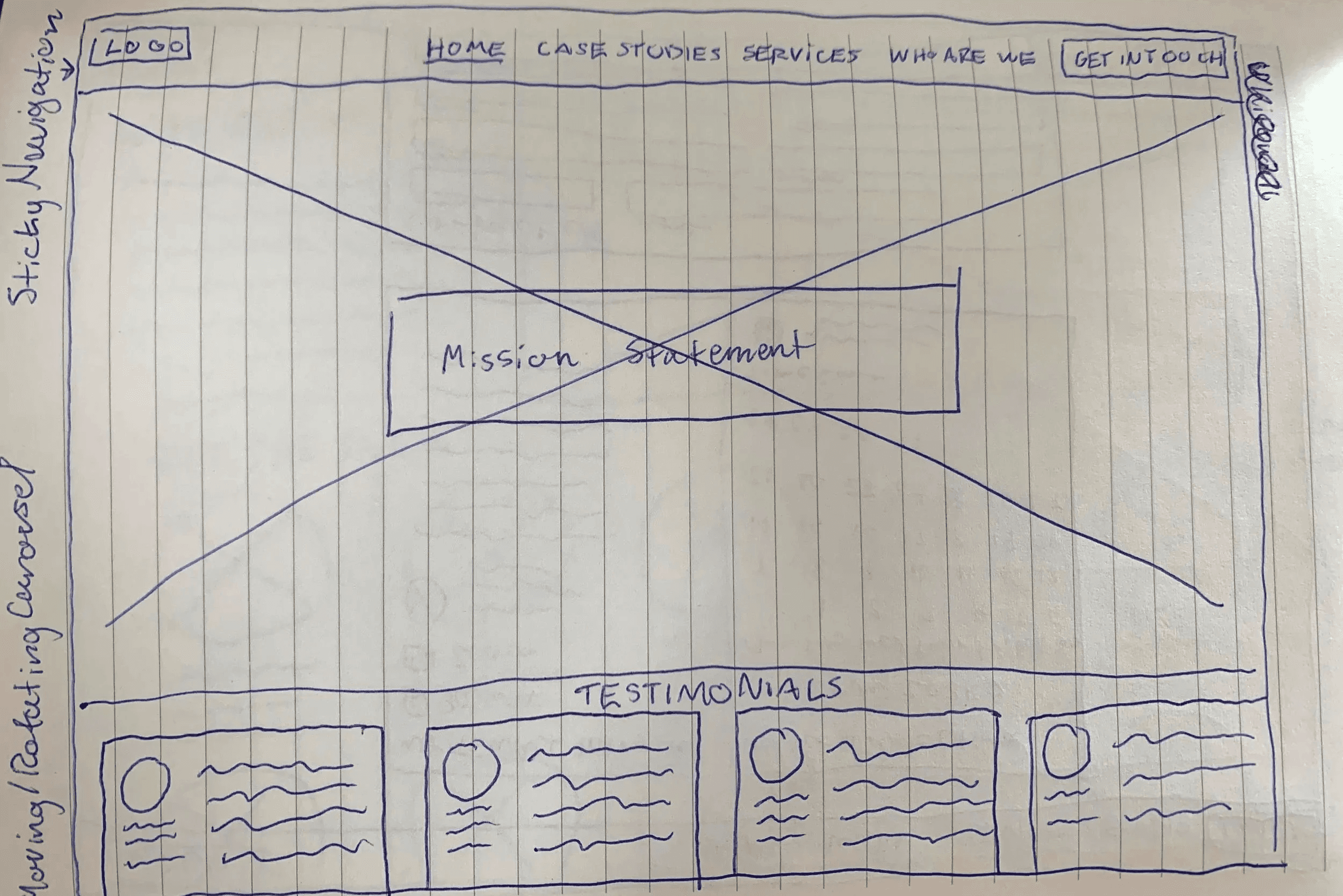


Every page was structured around a single question: what does Jordan need to feel ready to reach out?

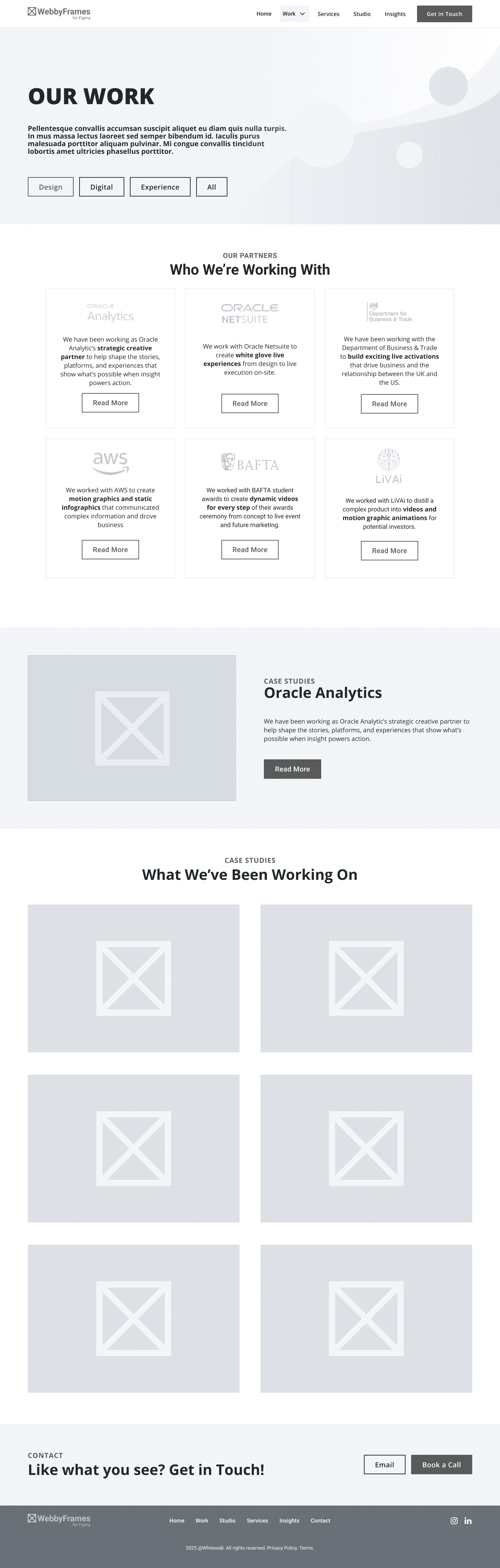

Contact was the easiest part. Credibility and culture needed more scaffolding.
2 of 3 completed
TASK 01
“Show me how you assess the company’s experience”
Objective: Would users find proof of expertise on their own?
Result: Users didn't navigate the way I'd designed for: one skipped the homepage for the Studio page, and the word "experience" read as "the whole site" for others. Underneath, greyed-out wireframes made work hard to judge without images, and people reached for different proof, testimonials, named clients, scale, not just case studies.
People don't evaluate credibility the same way, and a homepage can't assume the scroll.
3 of 3 completed
TASK 02
“Show me how you learn more about the company's culture”
Objective: Could users find cultural-fit signals?
Result: I'd built a Studio page to carry culture; instead users read it off the homepage, the clients, the Insights, even the "international agency" line, overturning my own assumption. Two asks surfaced: explicit values and commitments (B Corp style), not culture implied by team photos; and clearer labels, since "Studio" and "Insights" confused participants from the non-creative sectors that make up much of Whitewall's client base.
Culture is judged across the whole site, and the navigation has to read to people outside the industry.
1 of 3 completed
TASK 03
“Show me how you reach out to the company”
Objective: Is contact low-friction?
Result: The two failures were the most useful data: a contact email linked nowhere and a Calendly went unlinked. But the deeper issue was trust, one user read Calendly as a marketing tactic rather than a route to a person, and wanted a trackable direct email plus a visible physical address as proof of a real company.
Contact isn't one flow. People want options, and the route they trust is itself a signal.
Consistent findings
The "Studio" page title confused all three participants. Users need a variety of ways to navigate and contact, because evaluation methods vary.
Jordan loves bold, accessible design. That's not a tension to resolve. That's the brief.


The same three tasks, tested again. What had improved, and what still needed work.
3 of 3 completed
TASK 01
“Show me how you assess the company’s previous experience”
Objective: This task tripped users at wireframe stage, so could they now read the company's experience straight from the work?
Result: Adding real images was the single biggest lift from the wireframe round, work became far easier to assess and the site more engaging. Two things still showed: users again took different routes to the same answer (reconfirming a homepage can't assume one path), and repetition between the homepage and work page read as a limited portfolio. The broken top-navigation link surfaced here, users reached the work via the footer.
Images do the trust work copy can't, but the navigation has to actually function.
3 of 3 completed
TASK 02
“Show me how you learn more about the company's culture”
Objective: Last round users found the team but wanted more, so would the prototype give them enough to judge fit?
Result: Users read culture more confidently, but repeated the wireframe round's strongest signal: they wanted values stated outright, a named values or D&I section, not culture left implied. "Insights" still confused participants, an unresolved carry-over. A hover feature on "What We've Been Up To" came up as a way to add context without leaving the page.
Values need to be said, not shown, and the jargon still needs fixing.
3 of 3 completed
TASK 03
“Show me how you reach out to the company”
Objective: Would the contact routes added after the wireframe round work for the people Calendly hadn't?
Result: The contact routes added after the wireframe round worked. The homepage email section resonated, users liked copying the address directly (the trackable route last round had asked for), one chose the form over Calendly because it didn't make them leave the site, and the budget drop-down was singled out for managing expectations early.
Giving people options fixed the round-one failure outright.
Across the Round
The visual system landed and optionality in contact paid off. The clearest remaining risk was functional, not conceptual, the broken top-navigation link had to be fixed before final build, and running this round so soon after the wireframes limited how much fresh feedback it surfaced.
A website that leads with proof, makes contact effortless, and feels like the start of a relationship, not a pitch.
The redesign aims to offer clarity and transparency: the company's offer, its people, and its processes. Designed for both the scanner who needs a quick read and the person who wants to go deeper.




Homepage
Proof and partner credibility up front, a contact prompt at the close. Clickable arrows guide the scroll, so the page never assumes a visitor will find their own way down.


